
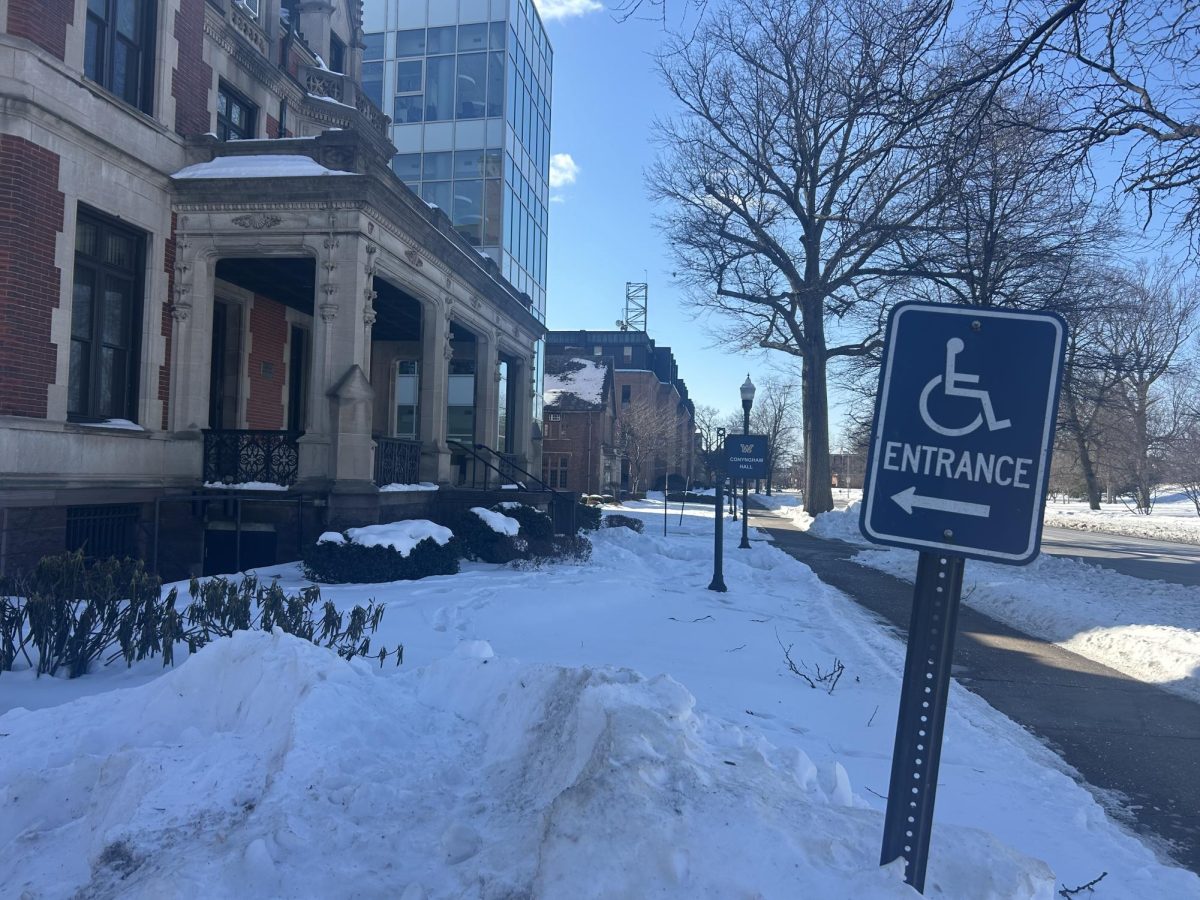
Wilkes University has many measures set in place to ensure that students with disabilities can have equal access and opportunities to various campus amenities. Yet, it is important to note that on occasion accessibility on campus is not up to par.
To start, credit needs to be given to the efforts that are made by faculty and the greater campus at large. Students and residents are very fortunate to have access to education and housing in many historic buildings dating back to the mid-nineteenth century.
Since there are so many unique buildings with rich history throughout the city of Wilkes-Barre, they are protected under the National Historic Preservation Act of 1966. An act that allows the building to be as close to its original state as possible. For many of these mansions such as Kirby Hall, elevators can not be installed into the old building, thus many students must resort to the stairs. The same can be said for older mansion style housing options on campus such as Roth, Waller, Catlin and Weiss.
Residence Life and Registrar have been very understanding in moving classes and residents to more accessible spaces such as when they change the location of an English class to Breiseth or when a student is moved to Evans which both have access to elevators.
Even the Office of Academic Success provides accommodations guaranteed to students through the Americans with Disabilities Act of 1990. Some of these accommodations include note taking services, extra time on tests and various tutoring services to ensure that all students have equal advantage at their education no matter what.
Lastly the Dorothy Dickson Darte Center for the Performing Arts received its renovations over the summer of 2025 to ensure that the building could be equipped for all audiences with its installation of an elevator. The lobby has even received new light fixtures and speakers to accommodate individuals who may be easily overstimulated during lectures or shows that live under the roof of the building.
Now, the campus has so many great modes of accommodation present for students, but there are times that the accessibility is not handled appropriately nor as efficiently as it should be. A few examples that many familiar with campus may have seen on their average school day may include: when handicap door buttons fail to open the doors, elevators out of service in the parking garage and even when the main elevator of the SUB only functions for the second and first floor on weekends.
This last one is especially concerning considering the dining hall with food access is located on the third floor, which causes issues for students and faculty members who have difficulty ascending the staircase to access this basic necessity.
Last year, students may remember the prolonged period that the elevator for the Cohen Science Center was down. This may seem like an inconvenience for students who do not want to walk to the fourth floor instead of using the various staircases. However, it poses a severe issue for members of the campus community who are unable to climb the stairs. Whether it be a student in a wheelchair, a faculty member with a cane, an athlete on crutches who just underwent surgery or even a student with visual impairment these are very few of the many cases why these seemingly overlooked problems are truly crucial to the functionality of campus.
Especially in these times of winter, snow and ice are major concerns for all students. The sidewalks near Michillini Hall and the area next to Evans Hall were particularly dangerous for students. The consistent extreme single digit temperatures did not help these conditions by any means. However, it took many days to shovel out pathways from residence halls and the sidewalks nearing the Greenway. For all students alike a slip on ice could be very serious resulting in a multitude of possible injuries. Signage and other forms of caution are important in times like these to ensure that students are aware of the dangers and can be pushed towards safer, alternative routes. Though Wilkes cannot control the weather, they can significantly help through means of communication and efforts at clearing areas quickly and with careful attention.
Disabilities come in all shapes and sizes and can easily be overlooked even unintentionally. That is why it is important to push for stronger accommodations on campus to ensure that all students are seen and feel safe and equal.