
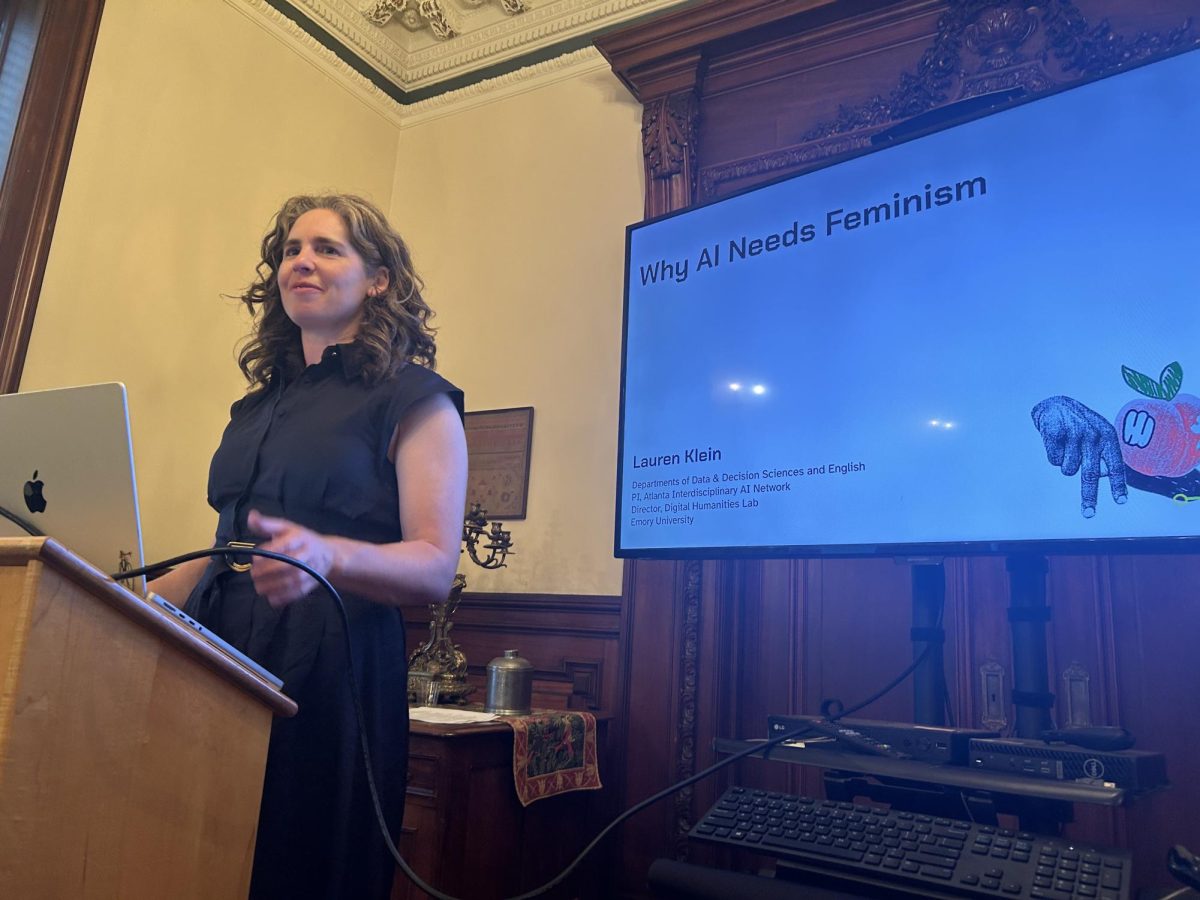
On Tuesday April 14, and Wednesday April 15, scholar and writer Dr. Lauren Klein visited Wilkes University to conclude this year’s Allan Hamilton Dickson spring writers series. During her two-day visit, Klein held a workshop for different English classes on both days and on Tuesday, she held a public reading.
Klein is a data and decision sciences and digital humanities professor at Emory University. She also directs the Digital Humanities lab and the Atlanta Interdisciplinary AI network. In her research, she utilizes computational and critical methods to explore critical issues and questions in regards to gender, race and justice in the United States.
Klein is a co-author alongside Catherine D’Ignazio of the award-winning book, “Data Feminism”, she is the co-editor with Matthew K. Gold of “Debates in the Digital Humanities” and she is the author of “An Archive of Taste: Race and Eating in the Early United States”. Her next book, “Data by Design: From the History of Visualization to the Future we Need” will be published through MIT press coming out in the Fall of this year.
On Tuesday at 2:30 p.m., Dr. Klein began her visit at Wilkes by dropping by Dr. Helen Davis’s Intro to Digital Humanities class held in room 108 in Kirby Hall.
The topic she presented to the students was about detecting the racial biases in storytelling generated by generative AI systems.
“The reason to audit is that it’s not hard to look under the hood of the biases these algorithms create because the way these models produce words is much easier than they let on. This lesson is to become better informed evaluators of the amount of AI products being dumped on us.” Dr. Klein explained. She stated this because it was one of the reasons that biases show up in AI-generated stories as most of these AI systems are trained to copy off of popularized social biases.
For the class activity, Dr. Klein had the participants generate a story with the prompt, “Write a story 100 words or less of an American data scientist who teaches AI to a newcomer to the field.” This prompt would be put into Klein’s chosen generative-AI model, Ai2 Playground due to the fact that it doesn’t steal data from the users unless its given permission to by the user.
The results of the activity was as expected, the dominant scientist role was usually characterized to be a male and the student role was usually a woman or a non-white person.
Later at 7 p.m., that same day, Dr. Klein presented an open reading to the public in the Kirby Hall Salon. Her presentation was titled, “Why AI needs Feminism”. This presentation was inspired by Klein’s previous work, “Data Feminism”.
“That book was written and published right before AI blew up the way it did in the public eye, I feel that a lot of what is in this book can resonate with generative AI and its similar lack of a feminist and humanistic touch.” Dr. Klein said.
Klein provided the core seven elements she created in “Data Feminism” which examined the seven ways she has studied the topic of data lacking a feminist and humanist touch. Those seven being: to examine power, challenge power, rethink binaries and hierarchies, elevate emotion and embodiment, embrace pluralism, consider context and make labor visible. These elements were based on women and gender studies approaches to critically analyzing feminism.
In addition to this, she noted a surprising discovery by Mimi Onuha made in 2016 called the Library of Missing Datasets. According to Onuha’s study, missing datasets are her coined term for “the blank spots that exist in spaces that are otherwise data-saturated.” The type of data that seem to be missing are data containing important information affecting vulnerable and marginalized groups.
“From information about LGBTQ+ older adults being discriminated against housing to seeing how much Spotify pays for each of its artists per play of song, the information of these missing datasets will unfortunately not see the light of day unless we do something about it.” Dr. Klein said.
She proceeded to talk about different individuals and groups who help in collecting and sharing data that are missing from the list. One of those groups is Data Against Feminicide, a project led by MIT professor and co-author of “Data Feminism”, Catherine D’Ignazio, Silvana Fumega from the Idaho Digital Learning Alliance and Helena Suarez Val, the project leader of Feminicido Uruguay.
According to the Data Against Femicide website, Data Against Femicide is a project that explores the need for accurate and appropriate data of violence against women around the world.
The three key objectives of this project include: fostering an international community of practice about femicide data, developing tools to support the collection of femicide data from media sources and supporting efforts to standardize the production of femicide data where appropriate.
The following day, Dr. Klein concluded her visit to Wilkes stopping by Dr. Mischelle Anthony’s Early American Literature course.
During this presentation, Dr. Klein talked about generative AI’s inability to produce well-written forms of poetry. Particularly, it fails to follow the rules of a duplex poem.
The duplex form of poetry was created by poet Jericho Brown. This form is a mash-up of classical poetic forms, such as a pantoum, sonnet and ghazal.
“If you ask Chat-GPT to write a duplex, it’ll more than likely copy off of Jericho Brown’s poems since its algorithm is trained off of copyrighted material. They don’t pay the poets, obviously, but they’ll still use them.” Dr. Klein stated.
For the activity, students were prompted to feed the Ai2 Playground algorithm, four separate prompts that would get the algorithm to attempt to write a poem in the duplex style. The result of the activity? The AI system wasn’t even close to following the rules of a duplex nor was the poetry it produced any good.
