
At first glance, E. coli is often associated with foodborne illness and contamination warnings. But new research conducted at Wilkes University is helping reshape that perception by exploring the bacterium’s potential environmental benefits.
Assistant biology professor Matthew “Skippy” Jennings and a team of undergraduate students recently published research examining how E. coli can help produce calcium carbonate, a compound widely used in industries such as food production, cosmetics, paper and steel manufacturing. The findings, which highlight a more sustainable way to produce the mineral, were published in the peer-reviewed journal Public Library of Science’s journal PLOS ONE.
The research focuses on understanding how microbes can precipitate calcium carbonate, the primary mineral found in limestone. Calcium carbonate is an essential material in a wide variety of products and manufacturing processes, but traditional industrial production methods are energy intensive and release large amounts of carbon dioxide into the atmosphere.
Jennings and his team are investigating whether microbes could provide a more environmentally friendly alternative.
“Right, so we study microbes that we collected from caves, and these microbes help to precipitate calcium carbonate which is the main mineral that makes up limestone,” Jennings said. “So, calcium carbonate is used in a lot of different industries but the traditional way of making it is very energy expensive and releases a lot of carbon dioxide.”
Instead of relying on those traditional processes, the research examines whether microbial activity could produce the mineral naturally.
“So, we’re trying to figure out how do these microbes precipitate calcium carbonate. If we can figure that out, can we increase the rate at which they make it and then potentially use them to make calcium carbonate for industrial purposes rather than relying on the energy intensive process which produces a lot of CO2.” Jennings stated.
While the project ultimately focuses on microbes collected from caves, the research initially uses E. coli as a model organism. According to Jennings, the bacterium’s genetic accessibility makes it easier to study and manipulate in a laboratory setting.
“E. coli has a lot of useful genetic tools that you can use to manipulate it,” Jennings said. “The fact that it’s so easy to work with, more easy than the cave strains we were collecting.”
By conducting experiments on E. coli, researchers can identify the genetic mechanisms responsible for calcium carbonate production and later apply those insights to other microbes.
“So, the idea is: do all the genetic manipulation in E. coli and based on what we found that’ll guide our research. Currently what we’re doing is trying to manipulate the cave strains to do the same thing but now we know what to look for and what to do,” Jennings said.
The findings have already produced unexpected discoveries. One of the most surprising results came when researchers identified a gene connected to the process.
“The most surprising thing is that the gene we identified is a transporter but it’s not a transporter of calcium it’s a transporter of zinc,” Jennings said. “So, we were expecting to identify some calcium transporters as important but that turned out not to be the case.”
Beyond improving industrial efficiency, the research could also have broader environmental implications, particularly in the fight against climate change.
According to Jennings, the microbial process not only avoids releasing carbon dioxide but may actually help remove it from the atmosphere.
“Well, we know from stable isotope labeling that when the cave strains make calcium carbonate the carbon comes from CO2,” Jennings said. “So not only are we not releasing CO2 because we’re not using the intense heat necessary to make calcium carbonate, but we’re also actually capturing carbon from the atmosphere and turning it into a mineral.”
This dual effect, reducing emissions while also capturing carbon, could make the microbial process especially valuable for industries looking to lower their environmental impact.
“So, attacking the problem of CO2 in the atmosphere from two directions, not releasing as much of it and also capturing some of it to put into calcium carbonate,” Jennings said. “So, there’s potential for other industries that don’t use calcium carbonate to perhaps use these as a way to offset the carbon dioxide that they do release by just capturing some and turning it into rock.”
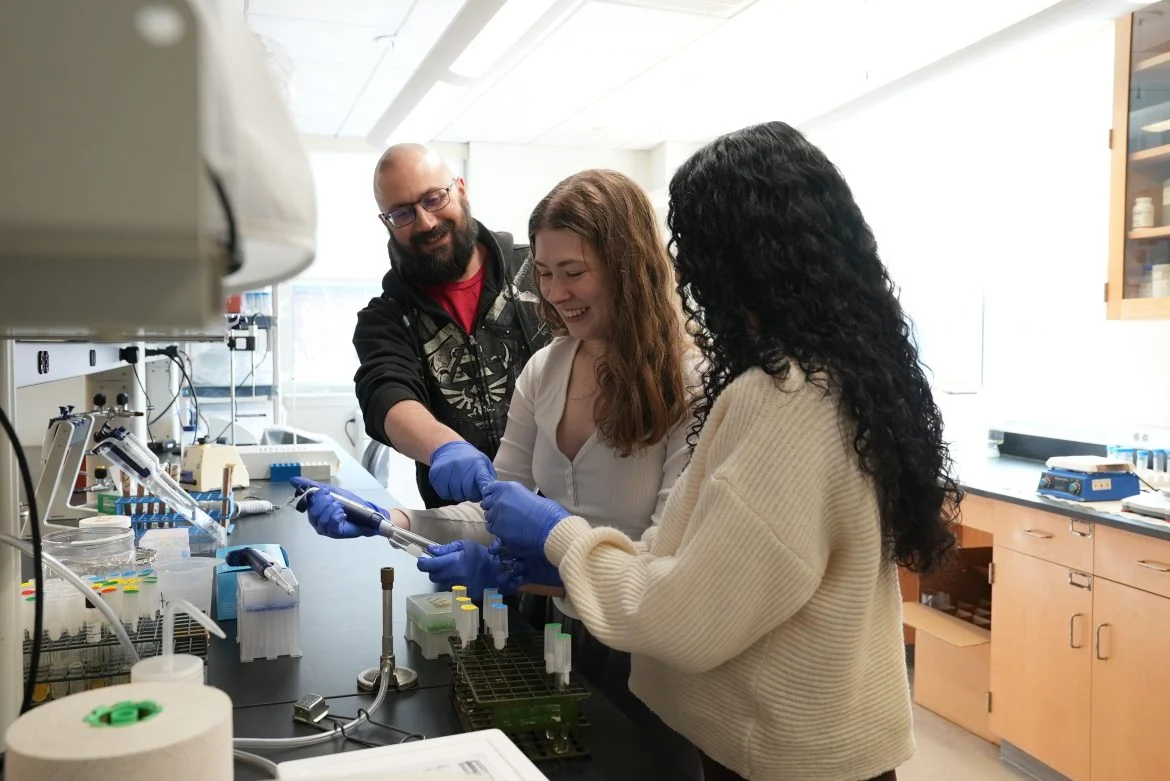
Undergraduate students played a significant role in the research process. Jennings worked closely with biology students throughout the project, providing training and gradually giving them more independence in the lab.
“So, I was already working on this project before I came here so I already knew what I wanted to do but Sara and Bisma joined me pretty early in their careers here at Wilkes,” Jennings said. “So, the first year was me training them in what to do and then these past two years I’ve basically just been giving them a list, like this is what we need to do and then they just do it on their own.”
Students involved in the research are currently completing their senior capstone projects, which include presenting their findings and conducting final experiments.
“Right now, they’re actually working with the cave strain itself and we’re again using what we learned in E. coli. We’re trying to figure out what genes are involved in the cave strain, and can we manipulate them so that they make more of the calcium carbonate than they normally do,” Jennings said.
According to the university, students involved in the research also gained experience presenting their findings at scientific conferences and contributing to a published academic paper.
Although the research was recently published, the project itself has been developing for several years.
“Well, I started the project when I was a postdoc, so I was a postdoc in 2018 so since then off and on,” Jennings said. “I continued working on it when I came here so I guess it’s so about eight years.”
The work also experienced interruptions during the COVID-19 pandemic when laboratory operations temporarily shut down.
Even so, Jennings says the long timeline has allowed the research to evolve and grow as new students joined the project and new experiments were conducted.
While the project has already produced significant findings, Jennings believes there is still much more to learn, particularly about the unique microbes found in cave environments.
“For me I’m more interested in seeing how unique the microbes that live in caves are compared to other types of microbes,” Jennings said. “So if we can identify some unique features about them that set them apart or allow them to survive in caves compared to other types of bacteria that might give us a better understanding of the microbial ecosystems of caves compared to other places that are not well studied.”
Jennings also encourages students interested in research to get involved early in their college careers.
“I would say don’t wait, you know even if you’re a freshman and you’re interested in research, reach out to professors who are doing research that you are interested in and see what their situation is,” Jennings said. “The sooner you start the more likely it is that you’ll get to do some interesting stuff.”
As the project continues, Jennings and his students hope their work will contribute both to scientific understanding and to the development of more sustainable industrial processes.