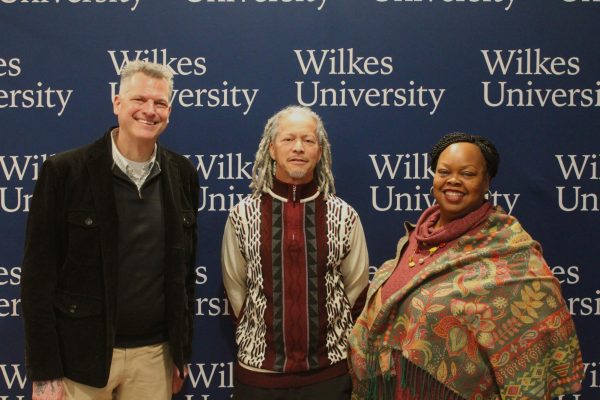
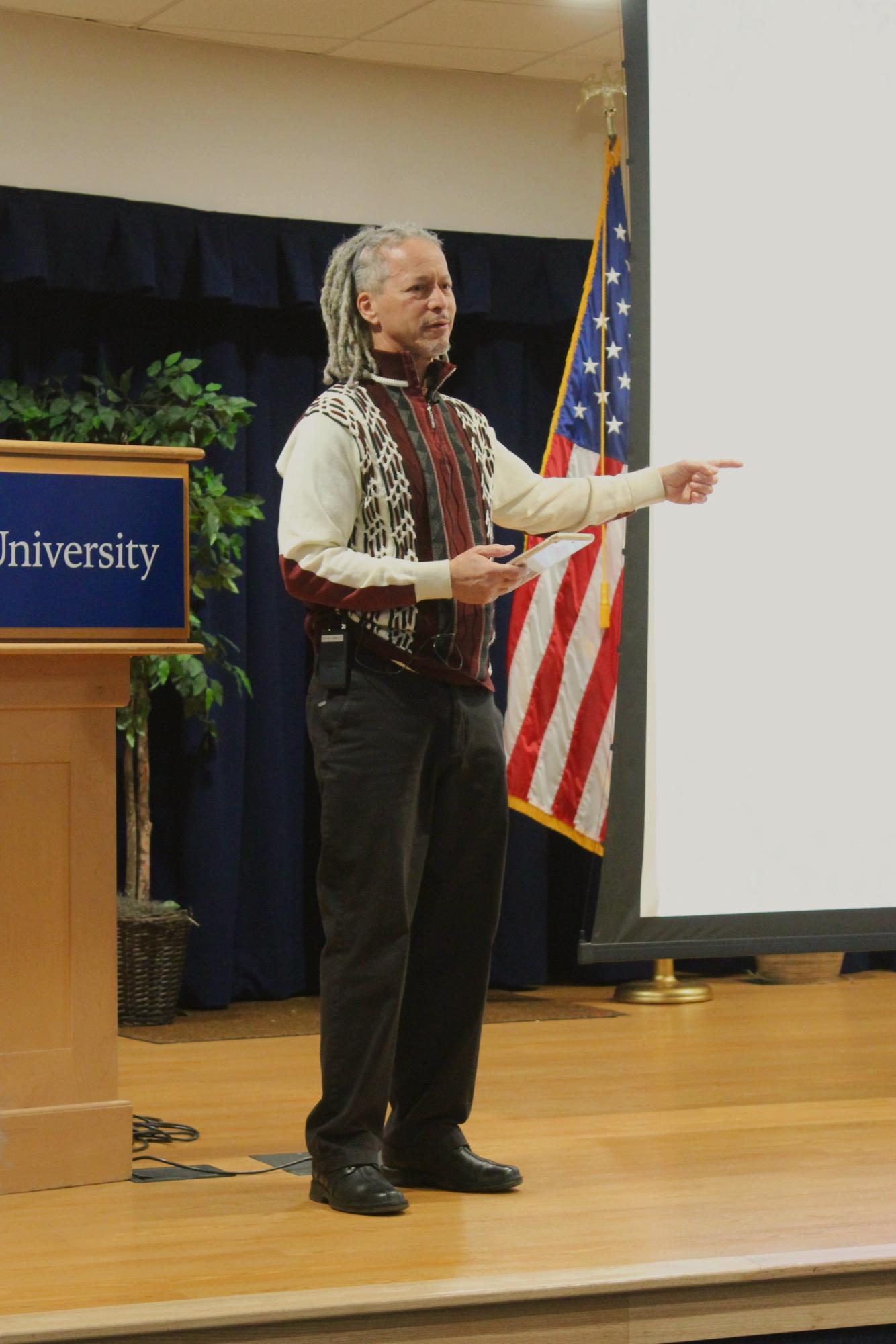
At Wilkes, the Division of Global Cultures, the Associate Provost for Academic and Diversity Affairs and the Dean of the College of Arts & Sciences introduced Dr. Scott Hancock as the 2026 Black History Month Keynote Speaker. Dr. Hancock is an associate professor of history and Africana Studies at Gettysburg College. He earned a Ph.D. in Early American History in 1999 after spending fourteen years working with teenagers in crisis. His writing has appeared in scholarly journals and anthologies, including The Civil War and the Summer of 2020 and They Are Dead and Yet Live. He also wrote Walk Up The Hill: A College Student’s Guide to Scholar Activism. On Tuesday, February 24, Wilkes faculty, staff and students gathered in the JPAC to discuss the unfair rule of law in the US with Dr. Hancock, its historic impact on many people, and the need to challenge it.
After a brief introduction by Dr. Kovats-Bernat, director of Africana Studies at Wilkes, Dr. Hancock showed the 1992 music video “It Was a Good Day” by rapper Ice Cube. The video follows an African American character during a normal day that ends with police raiding his home. Dr. Hancock explained that the video reflects “an expression in the lack of faith many black Americans have” and highlights skepticism about true equal treatment in the US legal system. He stated, “On any given day, you can do everything right and nothing wrong, and that day can end up unpredictably bad. While that can apply to everyone, it is a common reality for African Americans, and Ice Cube captured this idea very well. The end of Ice Cube’s good day isn’t for many people a nightmarish dream; it is their reality.”
The Gettysburg College professor explained that the treatment by law officers undermines the historical promise of America’s “Great Experiment.” He cited Ben Franklin’s famous reply about what kind of government he was trying to create: “a republic… if you can keep it.” Explaining that establishing a republic is easy but preserving it is harder. Dr. Hancock added, “Yet we hope for better, and we work for better” introducing his next idea: “We are optimistic realists, not realistic optimists,” and explained how this mindset is necessary for reform. Realistic optimism begins with fundamentally positive outlooks, but it’s tempered by realism. But optimistic realism begins with a starting point and being grounded in realism to be able to assess situations as they truly are. No matter the reality, optimistic realists maintain hope and a constructive attitude despite those negative realities.
As an example of an African American optimistic realist, he recounts the story of Sarah Cook, a young woman who bravely escaped from slavery during the Civil War, fleeing Virginia and the Confederacy. In the fall of 1863, she ran away with Aaron Smith, whom she later married. After their marriage, Aaron enlisted and Sarah became pregnant. She moved to Baltimore to work and soon received heartbreaking news that Aaron had been killed, leaving her a single, widowed mother to their child, Joseph. Seeking a government pension for Aaron’s service, she spent 20 years trying to prove her marriage to federal law officers. Despite her efforts, Sarah eventually passed away without providing enough evidence. Nevertheless, as Dr. Hancock explained, “Sarah’s story is one of persistence and singular focus. For over twenty years, she kept at this, an example of optimistic realism, thinking that a favorable outcome–a good day–was possible while probably knowing a poor outcome was possible.” He added, “If she can persist for decades, then we can persist too,” concluding, “Some of you probably have these stories of making the impossible possible, which can happen only in the rigorous grounding of the truth and evidence, which is what you are here to do as students, to put into practice to become the next leaders of America.”
Dr. Scott Hancock continued by explaining that his varied career in education and social services led him to study the historical effects of the American legal system on African Americans. Dr. Hancock explained a motivation to not only study but bring forth individuals lost to history. Additionally, he is currently working to place Black voices back into history through sites like the Gettysburg battlefield. As a first-generation college student, Dr. Hancock spoke of his family’s history, saying, “It is because of them that I can stand here today as one of their descendants,” and that he can speak to future generations to encourage them to work together to reform American law so that it protects all its citizens equally.